


Nezesudik's Journey to the Land of the Brobdingnag
1993
Performance on the margins of the Russian-Dutch collaborative art project "Exchange", Moscow
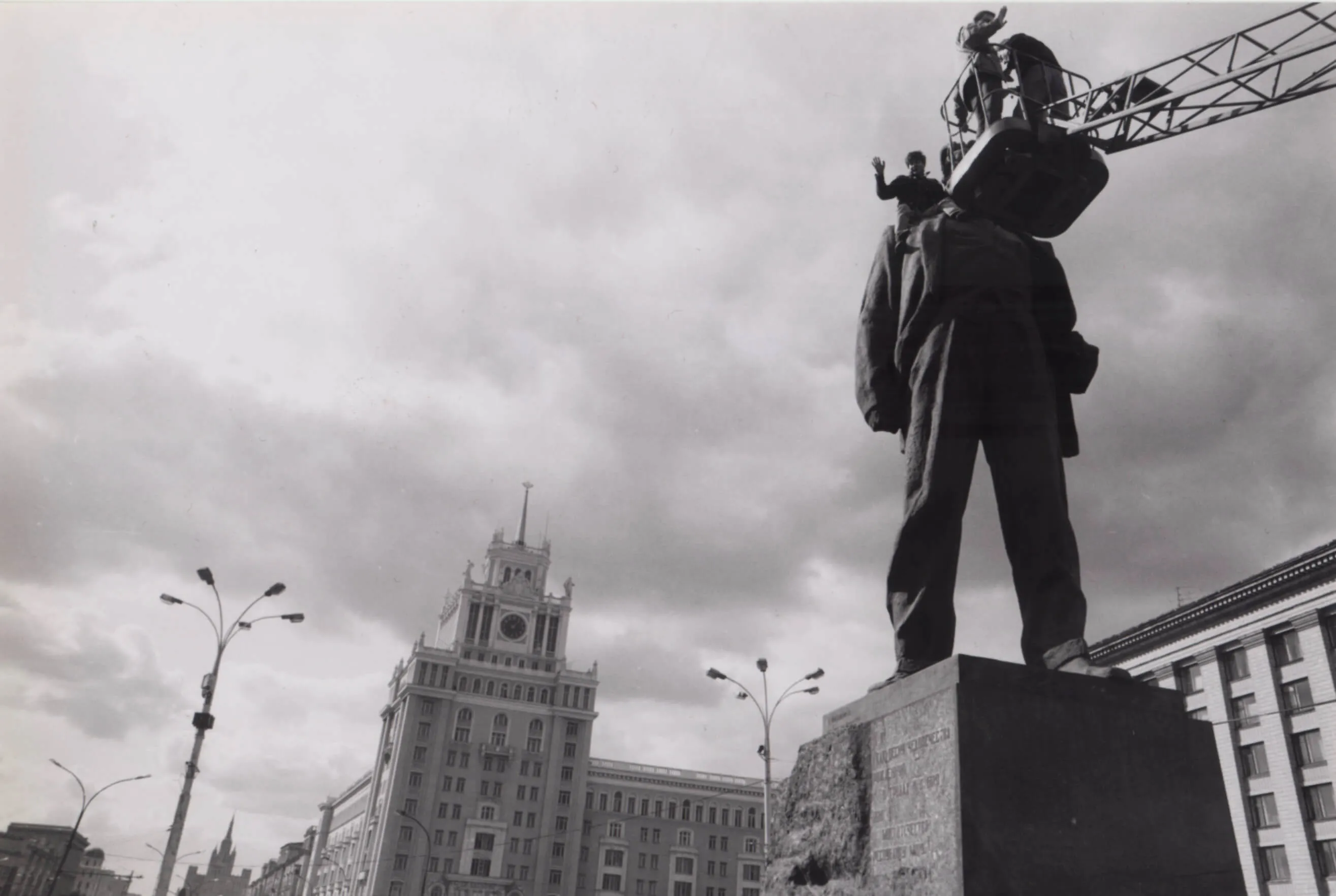
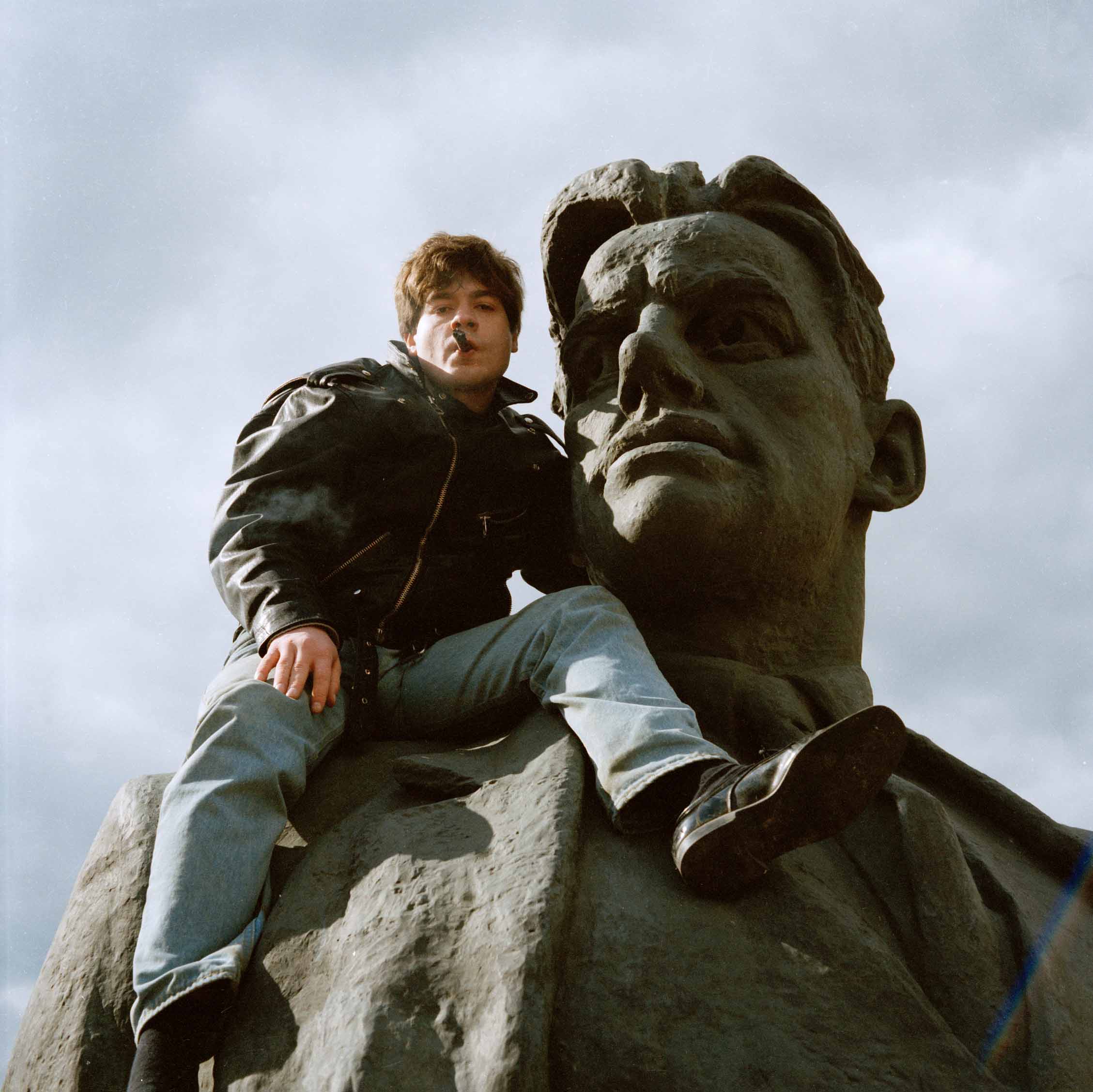
The photo features Anatoly Osmolovsky sitting on the shoulders of the Moscow-based monument to the poet Vladimir Mayakovsky. It is a photo documentation of the 1993 performance. Without notifying the authorities, the young artist climbed up the monumental statue in the public square in the north-west of Moscow which received its name after the great Russian poet. The poet Mayakovsky is considered the symbolic figure of the Russian avant-garde. Before his death, he started supporting the ruling power.
By erecting a monument to the Futurist poet, the Soviet regime seemed to canonize him as a revolution hero, and this posthumous recognition of the avant-garde defanged him, consigning him to the archives of history. This ambiguity in the substitution of concepts became especially evident in the liberal-criminal Yeltsin-era Russia of the 1990s, which consigned the entire Soviet pantheon (including the avant-garde) to oblivion. Thus, amid the cultural establishment’s frenzied hype about Malevich and Rodchenko, Mayakovsky’s figure seemed to fade into the shadows in the 1990s.
The artist brings back to life the historical mystery of fragmented memory recollections, crowned with the unique statue of Mayakovsky. He calls its performance “Nezesudik’s Journey to the Land of the Brobdingnag,” after the legendary giants in Swift’s novel. The artist starts his journey from the story of a fictional character Nezesudik, whose name in a constructed auxiliary language Volapük stands for something redundant.
The performance has a well-structured avant-garde Dadaist meaning as it ruins the essence of the historical discourse, being imposed by the power both at performative and conceptual levels. The words sound like a poetic gibberish of the Russian futurist poets, like dir bul shyl of the poet Krucheny, or the Dadaist Kurt Schwitters, provocative towards the pretentious toponymics.
In the Soviet times, the question of avant-garde’s legitimacy had already been raised by the young poets of the 1960s l in opposition to authority ike Voznesensky and Yevtushenko, among others. Their poetry readings around the statue of Mayakovsky would often draw large, enthusiastic crowds. In the 1990-х, Osmolovsky continued the tradition.
With his performance, he showed that the memories of the avant-garde of the new times, which went through totalitarianism, was not about the worship of statues, but about specific social actions addressing the pain points of the amnesic power that is evolving while its essence still remains immutable.
Konstantin Bokhorov


.jpeg)