


ETI-text (Dick on Red Square)
April 18, 1991
Location: Red Square, Moscow
Authors: ETI group (“Expropriation of the Territory of Art”)
Participants: 14 people — Anatoly Osmolovsky, Grigory Gusarov, Alexandra Obukhova, Milena Orlova, Maksim Kuchinsky, punks from Gogolevsky Boulevard, etc.
Description: The participants lay down on the cobblestones, forming the word “khui” (“dick”).The action was carried out on the eve of Lenin’s birthday and was interpreted as an affront to his memory.
Theory
A few words must be said about the issue of precedence. The group “Mukhomor” almost immediately after this action claimed their own “priority” in laying out this sacramental word with human bodies. As later became known, in some earlier year (long before ETI’s action on Red Square), the “Mukhomors” had “written” the word “khui” with three people on the snow and photographed it.
In the postmodern era, any claims to priority are highly dubious. There is evidence that long before the “Mukhomors,” the conceptualists the Gerlovins had already performed this gesture (though no photograph survived). And the “Mukhomors” themselves began talking about their action precisely after the scandalous fame of ETI’s action.
Here again a typical postmodern trope is at work: the shifting of importance between cause and effect. Without the effect(the Red Square action), the significance of the cause (the Mukhomors’ action), or even the awareness of its existence, would not have been recognized by anyone. Thus, the effect becomes the cause of the cause. Context outweighs text. For works that are visually and conceptually simple, this seemingly banal idea is actually quite accurate. In other words, the word “khui” acquires meaning precisely because it is laid out on Red Square — this is the contextual precision of the gesture.
The “innovative meaning” (the “additional element,” to use Malevich’s term) of the action lies not in writing some word with human bodies, but in carrying out the action specifically on Red Square. Moreover, the “background” (the cobblestones of Red Square itself) is just as important as the “message.”
There was, of course, a certain continuity (at least formally) between ETI and earlier conceptualist practices. Conceptualism in all its varieties — from the “comic” versions (“Mukhomor,” “Nest,” etc.) to the “analytical” (“Collective Actions”) — was an important historical phenomenon for ETI. The key difference was ideological (political). ETI operated within a left-radical discourse (in various forms) — politics was an essential structural part of the activity. For the conceptualists, the “formal moment” was more important.
But the most important aspects of the new period were public visibility and direct engagement with mass media (in a sense, newspapers and television served as the documentation of all actions).
Preparation and Implementation
Fourteen people were supposed to come — thirteen to form the “text” while lying down, and the 14th (G. Gusarov) was to cover for us and distract the cops.
Five people showed up at the meeting — art historians Alexandra Obukhova and Milena Orlova, anarchist Max Kuchinsky, and I (Anatoly Osmolovsky) with Grigory Gusarov.
Then we went to look for people at Arbatskaya metro station near the Gogol monument. There we convinced several hippies and punks (eight people in total) to come with us. Now we were 13 people; we needed one more, or Gusarov would have to lie down as the thirteenth.
When I positioned everyone and lay down myself, the last person turned out to be a random passerby who became the thirteenth.
We lay there for about a minute. The photographer was a correspondent from MK (“Moskovsky Komsomolets”), who published an article with the now-famous photo the next morning. The negative and the good print no longer exist (or are lying somewhere forgotten in someone’s archive).
A criminal case was opened under Article 206, Part Two (Malicious hooliganism distinguished by exceptional cynicism or particular audacity).
Since the action took place on the eve of Lenin’s birthday, it was also interpreted as an assault on his memory. Three months later, under pressure from the cultural community (“Memorial,” the Russian PEN Center, director Sergei Solovyov, poet Andrei Voznesensky), the case was closed due to lack of criminal elements.
Holy Place, Ogonyok, May 1991
The movement “ETI,” which stands for “Expropriation of the Territory of Art,” is famous for its scandalous actions. Their favorite site is Red Square. On it, in the fall, ETI shot the film “Price 2.20” (about sausage, that is); on that same square they set up a refrigerator on New Year’s and delivered speeches from it. And now — a new stunt!
On April 18, on the cobblestones of Red Square, ETI laid out an obscene three-letter word with their bodies, for which they were immediately taken to the police. As it turned out, the incident didn’t end with just a protocol and a fine for ETI leader Osmolovsky. He faces serious trouble, up to criminal prosecution. At the moment, law enforcement authorities are demanding that Osmolovsky answer: was it a political action or ordinary hooliganism? Hoping to be understood, Osmolovsky explained that the action had no political meaning, that it was purely artistic, and that its goal was “the desacralization of Red Square and making it a truly public place.”
<...>
Ogonyok, May 1991
“What a Performance!” Moskovsky Komsomolets, April 19, 1991<...>The youth movement ETI is already known for its unconventional performances. At 2 p.m. on Red Square, 13 young men and women laid out a three-letter word with their bodies. Police officers quickly arrived, lifted the participants off the cobblestones, and invited them to the nearest station.
<...>
Moskovsky Komsomolets, April 19, 1991

1991 – action “E.T.I. – text” on Red Square, photo of our activist
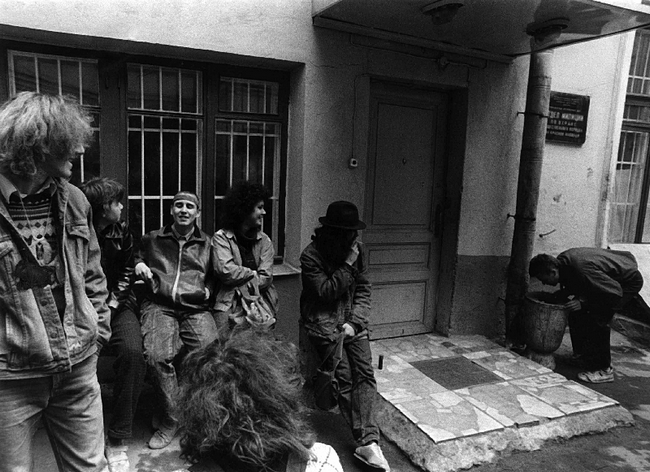
Activists of ETI movement after arrest near to Red Square police department