Order of the Army of the Arts
1997
XL Gallery, Moscow
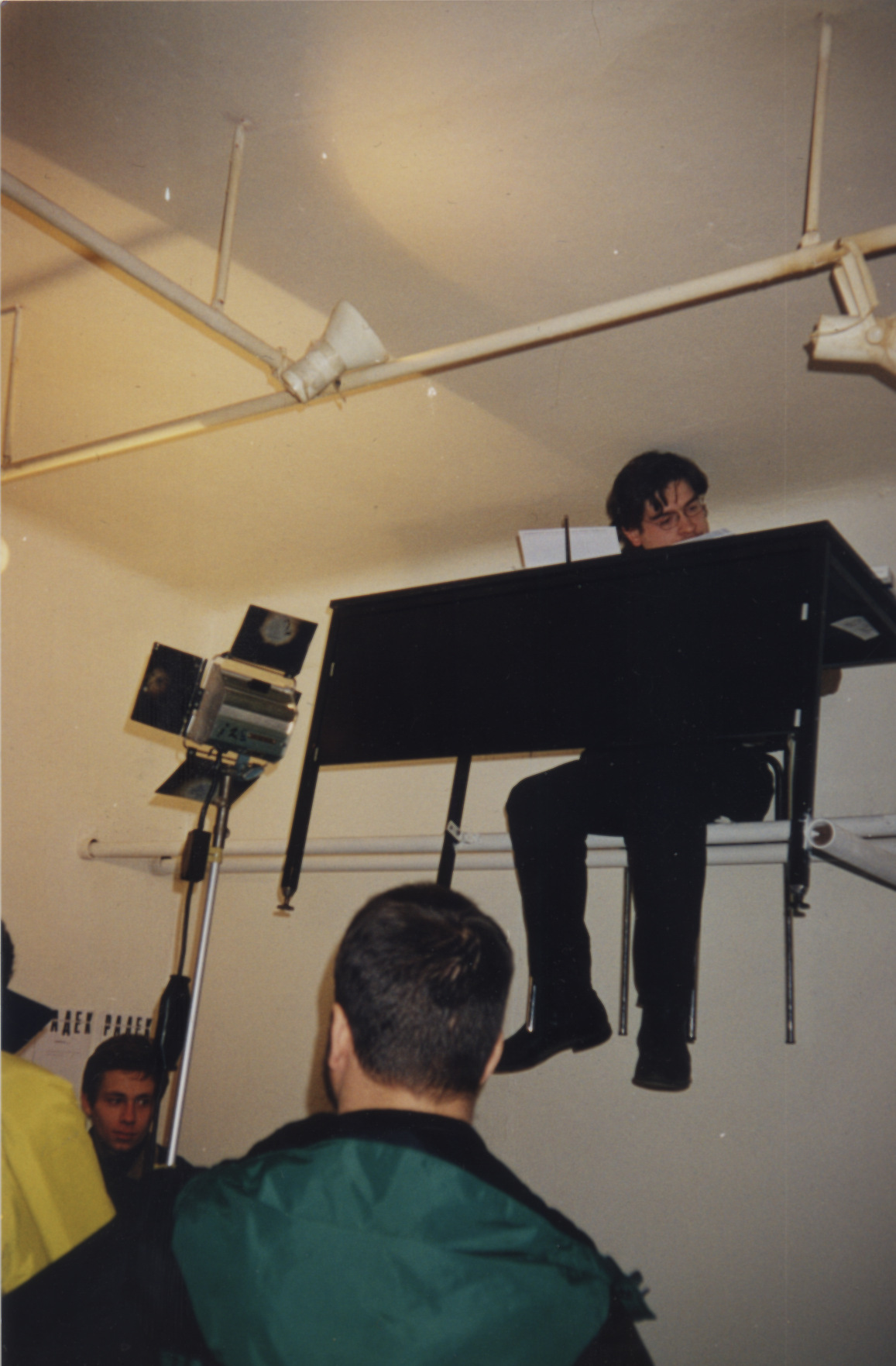
In 1997, at Moscow’s XL Gallery, Anatoly Osmolovsky showcased a curated collection of work titled ‘Order of the Army of the Arts’ — a performative installation which reimagined the art field as a hierarchical ‘army’ governed by a system of decrees.
The artist stood in the attics of the gallery space: a table and a chair were suspended from the ceiling shaping an improvised “office.” The audience could see only his feet in black boots and hear the clatter of a typewriter. As the performance unfolded, Osmolovsky would read the names of the ‘soldiers of the army of the arts’ and issued orders to them. The typed texts of orders were dropped down and were immediately displayed on the walls of the exhibition space.
Those orders were personally addressed to the prominent figures of artistic and intellectual scene. For instance, Ilya Kabakov was instructed to “receive the Presidential Prize and die in 1998,” while the artistic duo of Vitaly Komar and Alexander Melamid were told to “swap wives.” The philosophers Valery Podoroga and Mikhail Ryklin were instructed to “carve the phrase “This is not Valery Podoroga” on their foreheads’ and “give all their money to the poor,” respectively. The art circle of Pavel Pepperstein, Zurab Tsereteli, Alexander Solzhenitsyn and Vladimir Sorokin was given a mandate to “rebuild Russia.”
All orders were printed on the official letterhead of The RADEK magazine which resurgence was part of the art project.
Formally adhering to the asceticism of the revolutionary theatre of the 1920s and 1930s, the performance refers to the traditions of the avant-garde and the figure of Vladimir Mayakovsky, whose “decrees to the army of art” became an important historical precedent. In Osmolovsky’s work, the language of command functions as an artistic tool that reveals the structures of power, symbolic status and institutional roles within contemporary art.